The short answer
- The Serdi 3.5 covers 16 to 70 mm seats and is built for automotive and motorcycle multi-valve heads.
- The 100 ES and 2.0 ES cover 28 to 120 mm with a spindle of about 3 kW for large diesel, marine and industrial seats.
- The 4.5 Power covers 16 to 120 mm in one machine and works with guide inserts down to 4 mm.
- The Profile and Profile L cut seats with a CNC single point tool, so you can program, save and repeat custom seat shapes.
If your shop does valve jobs every week, the seat and guide machine is one of the hardest working machines on the floor. Buy one that is too small and you turn away diesel and industrial heads. Buy more machine than your work calls for and you tie up money and floor space you could have used somewhere else.
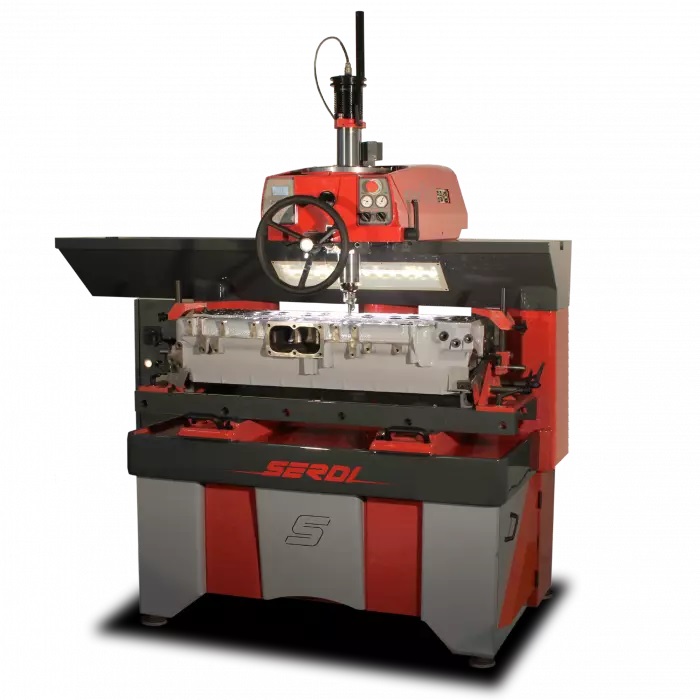
Serdi builds a full range of seat and guide machines, and you can see our full Serdi seat and guide lineup on one page. This guide compares each model using the specs listed on our product pages, so you can narrow the field before you call us for a quote.
What separates one seat and guide machine from another
Every machine here does the same basic job. It centers on the valve guide, then cuts a concentric seat to the right depth. What changes from model to model comes down to four things.
- Seat diameter range. This sets the smallest and largest seats you can cut. A machine that starts at 28 mm is a poor fit for small motorcycle heads, and a machine that tops out at 70 mm cannot reach a big diesel seat.
- Spindle power. More power holds a steady cut on hardened seat inserts and large diameters.
- Centering system. Serdi machines use air cushion centering so the spindle floats into line with each guide. The 3.5 and 4.5 Power use a triple air cushion system, and the 100 ES and 2.0 ES use a double air cushion system.
- Cutting method. Most models cut with form tools. The Profile series uses a CNC single point tool that follows the seat shape you program.
Serdi seat and guide machine comparison
Model
Seat diameter range
Spindle power
Spindle speed
Centering
Best fit
Serdi 3.5
16 to 70 mm (0.6 to 2.75 in)
1.5 kW
100 to 1,200 rpm
Triple air float
Automotive and motorcycle multi-valve heads
Serdi 100 ES
28 to 120 mm (1.1 to 4.72 in)
3 kW
80 to 840 rpm
Double air cushion
Automotive, diesel, marine and heavy duty heads
Serdi 2.0 ES
28 to 120+ mm
About 3 kW
Typically 80 to 1,000 rpm
Double air cushion
Busy shops with mixed automotive, diesel and performance work
Serdi 4.5 Power
16 to 120 mm (0.6 to 4.72 in)
2.2 kW
80 to 840 rpm
Triple air cushion
Small automotive heads through stationary engine heads
Serdi Profile and Profile L
About 16 to 120 mm
CNC controlled spindle
Variable, set by CNC
Air float
Programmable seat shapes for performance, diesel and OEM level work
SDMC BV60
16 to 60 mm (0.63 to 2.36 in)
1.2 kW
50 to 600 and 600 to 1,000 rpm
Triple air flotation
Motorcycle, small engine, automotive and light duty diesel heads
Swipe the table sideways to see every column.
Specs as listed on each product page. Every Serdi model in this table lists depth control to 0.01 mm (0.0004 in).
Serdi 3.5: built for multi-valve automotive and motorcycle heads
Seat range
16 to 70 mm
Spindle
1.5 kW
Speed
100 to 1,200 rpm
The Serdi 3.5 valve guide and seat machine is the most focused machine in the lineup. Its 16 to 70 mm seat range covers most automotive and motorcycle heads, from small four cylinders up to modest V heads. Triple air float centering lines the spindle up with each guide on its own, which matters on compact multi-valve heads where guides sit close together and may not be perfectly square.
The 3.5 fits performance shops, rebuild shops and custom engine builders whose work is mostly passenger car, motorcycle and light performance heads. It handles vertical and inclined guides with its fixture set, and it reads seat depth to 0.01 mm. If you rarely see a seat bigger than 70 mm, this is usually where the conversation starts.
Serdi 100 ES and 2.0 ES: wide seat range for diesel and industrial heads
Seat range
28 to 120 mm
Spindle
About 3 kW
Best for
Large, hard seats
Both ES models start at 28 mm and run to 120 mm, with a spindle of about 3 kW. That extra power and the large upper range are aimed at heavy duty, marine, agricultural and industrial heads where seats are big and inserts are hard.
The Serdi 100 ES runs 80 to 840 rpm, supports large and heavy heads on its fixture table, and offers an optional integrated vacuum tester so you can check seat seal before the head comes off the machine. The Serdi 2.0 ES is the next generation of that platform, with a speed range of typically 80 to 1,000 rpm depending on configuration and an air float table built for very large diesel and industrial heads.
The tradeoff is the bottom of the range. If a good share of your work is small motorcycle or compact multi-valve seats under 28 mm, an ES model on its own will not cover it.
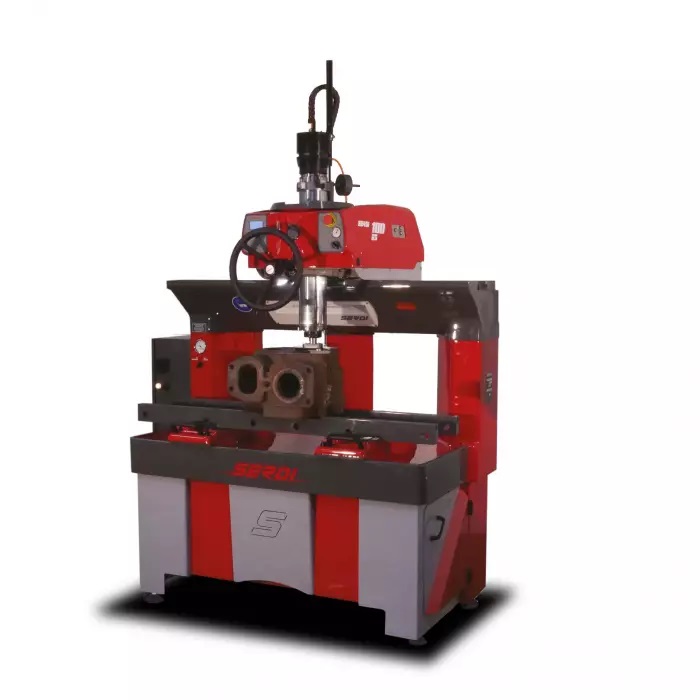
Air cushion centering floats the spindle into line with each guide before the cut.
Serdi 4.5 Power: one machine from small heads to stationary engines
Seat range
16 to 120 mm
Spindle
2.2 kW
Weight
About 1,500 kg
The Serdi 4.5 Power is the answer for shops that see a little of everything. It covers 16 to 120 mm seats, so one machine reaches from small automotive heads to large marine, diesel and stationary engine heads. Its 2.2 kW spindle runs 80 to 840 rpm, it works with guide inserts down to 4 mm, and the machine weighs about 1,500 kg (3,306 lb) on a rigid cast iron frame.
If you are replacing an older machine and your work runs from cars to tractors, the 4.5 Power is often the safer long term choice because you will not outgrow the seat range.
Shop tip: Pull your last three months of valve jobs and write down the smallest and largest seat you cut. That one range rules out most of the lineup before you compare anything else.
Serdi Profile and Profile L: CNC single point seat profiling
The Profile series works differently from the rest of the lineup. Instead of form tools, it uses a CNC controlled single point tool that follows a programmed path. That lets you cut multi-angle seats, radius profiles and blended shapes, then save the program and repeat it across every seat in a head or across a whole batch.
The Serdi Profile CNC valve seat machine and the Serdi Profile L both list a seat range of about 16 to 120 mm, depth resolution of 0.01 mm, air float guide centering and industrial 3 phase power. They are built for performance engines, diesel rebuilds, OEM level seat machining, motorsports and development work. If you need to match a specific seat design, or production batches have to come out identical, start with the Profile series.
Where the SDMC BV60 fits
The SDMC BV60 valve guide and seat machine sits alongside the Serdi models as a compact option for smaller heads. It covers 16 to 60 mm seats with a 1.2 kW spindle that holds a constant 18 N·m of torque across two speed ranges, 50 to 600 rpm and 600 to 1,000 rpm. It adds 200 mm of spindle travel, a 5 degree spindle swing for inclined heads and support for guide inserts down to 4 mm, and it ships with a NEWEN compatible carbide tooling package.
How to choose: answer these four questions first
What is the smallest and largest seat you cut in a normal month? This rules out most of the lineup on its own.
How much hardened insert and diesel work do you run? Large, hard seats favor the ES models or the 4.5 Power.
Do you need custom seat shapes or batch repeatability? If yes, look at the Profile series.
How many heads move through the shop each week? Higher volume makes fast centering and extras like the vacuum tester option pay off sooner.
Seat work is only half of a valve job. Our guide on how a valve refacer works and when to reface or replace a valve covers the other half.
New or used seat and guide machine?
Every Serdi model in this guide is available new. We also list used seat and guide machines as they come in, which can be a good way to add capacity on a tighter budget. With any used machine, ask exactly which cutters, pilots and fixtures come with it, because tooling is a big part of what it takes to get a seat and guide machine cutting in your shop.
Frequently asked questions
What is a seat and guide machine used for?
It centers on each valve guide and cuts a concentric valve seat to a set depth. Shops use it for seat recuts, guide work and full valve jobs on cylinder heads.
Which Serdi is best for motorcycle and small multi-valve heads?
The Serdi 3.5 is built for automotive and motorcycle heads with a 16 to 70 mm seat range. The 4.5 Power and the SDMC BV60 also cut seats down to 16 mm.
Which Serdi handles large diesel and industrial seats?
The 100 ES, 2.0 ES and 4.5 Power all reach 120 mm seats. The two ES models carry a spindle of about 3 kW, and the 4.5 Power covers the full 16 to 120 mm range in one machine.
What does a CNC single point seat machine do differently?
Instead of a fixed form tool, a single point tool follows a programmed path. That lets the Serdi Profile and Profile L cut multi-angle, radius and blended seat shapes and repeat them exactly from a saved program.
Do you ship seat and guide machines outside Florida?
Yes. We work with shops nationwide and help with freight, delivery coordination and setup guidance.

USA Equipment Sales 4 Less
New and used engine rebuilding and machining equipment, backed by a team with 50+ years of experience.