For an engine machine shop, bringing line boring work in-house can create more control over accuracy, turnaround time, and the range of services the shop can offer. But making that investment means choosing equipment that can handle the precision required for critical bearing and housing bores without making every job unnecessarily complicated to set up.
The Comec LBM950 Line Boring Machine is designed specifically for that balance. Built for reconditioning bearing seats in cylinder heads and engine blocks, the LBM950 combines CNC control with a rigid boring system, universal clamping, and a working range suited to many automotive and light-truck applications.
For shops considering an upgrade to their current line boring equipment—or adding the capability for the first time—the LBM950 offers a modern approach to a job where alignment, stability, and repeatability matter.
What Is the Comec LBM950 Line Boring Machine?
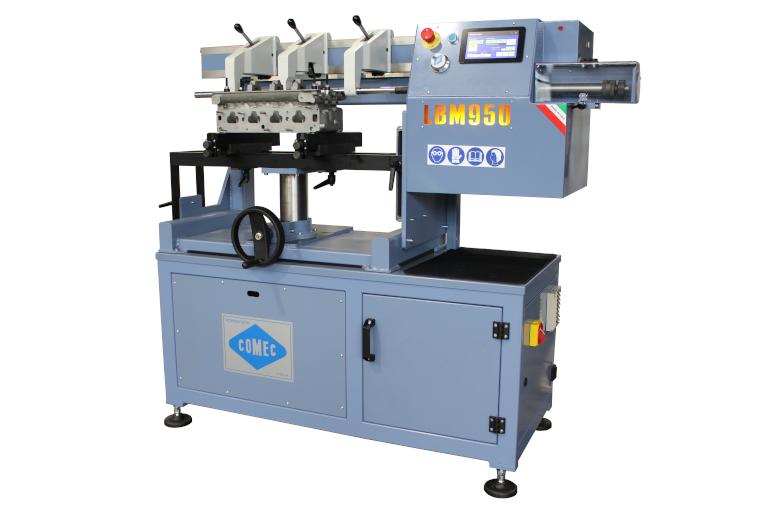
The Comec LBM950 is a CNC horizontal line boring machine designed for precision reconditioning work on both cylinder heads and engine blocks. Its applications include restoring camshaft housing bores in cylinder heads and crankshaft or main-bearing seats in engine blocks, making it useful for shops that handle a variety of automotive engine rebuilding work.
At the center of the machine is a chrome-bar drive system that combines linear ball-bearing feed with belt-driven rotation. The design is intended to keep the boring operation smooth and stable while reducing vibration and chatter that can compromise accuracy during precision machining.
The LBM950 has a boring range of 24 to 85 mm and accommodates workpieces up to 810 mm long and 300 mm wide. Its boring bar offers 190 mm of travel, while variable rotation from 0 to 400 rpm gives operators additional control based on the material, bore, and stage of the machining process.
That combination makes the LBM950 particularly relevant for shops performing automotive and light-truck cylinder head and block work. Rather than trying to make a general-purpose machine accommodate a specialized operation, shops get equipment designed specifically around maintaining alignment through a line of critical bores.
Precision Control for Cylinder Heads and Engine Blocks
Line boring leaves very little room for inconsistency. Main-bearing and camshaft bores must maintain the proper centerline through multiple bearing positions, which makes the stability and control of the boring bar an important part of the machining process.
The LBM950 addresses that challenge with three movable, rigid support arms for the boring bar. Supporting the bar throughout the operation helps maintain stability under load, while the machine’s linear-guide feed and belt-driven rotation are designed to produce smooth, controlled movement.
Operators control the machine through a touchscreen interface and electronic handwheel. Feed, rotation, and cycle parameters can be managed electronically, with both manual and automatic operation available depending on the job and operator preference.
The result is a machine designed to give engine builders more direct control over a precision operation. Instead of relying heavily on manual adjustments throughout the machining cycle, operators can establish the appropriate parameters and use the machine’s controls to create a more consistent process.
For shops already performing cylinder boring, honing, resurfacing, and other engine reconditioning work, adding dedicated line boring capability can help create a more complete block and cylinder head machining workflow.
A Flexible Setup for Different Line Boring Jobs
A line boring machine becomes more useful when a shop can move between different jobs without building an entirely new setup around every workpiece. The LBM950 is equipped with universal clamping fixtures for both cylinder heads and blocks, helping it accommodate different engine components within its supported working envelope.
Its movable supporting arms can also be repositioned around the workpiece and boring operation. That flexibility allows the machine to maintain proper support while handling different bore locations, component lengths, and setups.
The 24-to-85 mm boring range covers many of the camshaft journal and main-bearing seat dimensions found in automotive and light-truck applications. Combined with variable bar speed and controllable traverse, the machine can be adjusted to suit different stages of the boring process rather than operating at a single fixed setting.
For a shop handling a mix of engine work, this versatility matters. Equipment that spends most of its time waiting for one specific type of job is harder to justify than a machine capable of supporting a broader range of cylinder head and engine block applications.
The LBM950 is therefore not simply about adding another machine to the floor. Its value comes from giving a shop a dedicated line boring platform that can become part of a larger engine reconditioning process.
When Does the LBM950 Make Sense for Your Machine Shop?
The right equipment investment depends on the work a shop actually performs. A shop that rarely encounters line boring jobs may be better served by outsourcing them or considering a lower-cost used option. For an engine builder regularly sending line boring work elsewhere, however, bringing the process in-house can become considerably more attractive.
Owning a dedicated machine gives the shop direct control over scheduling and the machining process. Jobs no longer have to leave the facility solely because the shop lacks line boring capability, and the business may be able to accept engine work it previously had to turn away or subcontract.
The LBM950 is particularly worth considering for shops focused on automotive and light-truck cylinder heads and blocks that fit within its working range. Its touchscreen controls and electronic handwheel also give shops a more modern operating platform than many older line boring systems still found in engine rebuilding facilities.
The decision should ultimately come down to workload, component sizes, available floor space, budget, and the type of engines the shop expects to machine. USA Equipment Sales 4 Less works with engine builders and machine shops to compare those requirements against available new and used equipment rather than assuming one machine is right for every operation.
For a shop with the appropriate workload, the LBM950 can fill an important gap between outsourcing precision line boring and moving into a much larger heavy-duty machining platform.
Comparing the LBM950 With Other Line Boring Options
One of the most important steps in buying engine machining equipment is comparing machines based on the work they will actually be expected to perform. The LBM950 is designed primarily around cylinder heads and engine blocks for automotive and light-truck applications, but USA Equipment Sales 4 Less also offers line boring solutions for shops with different capacity, workload, and budget requirements.
For shops working with significantly larger diesel or industrial blocks, the AMC-Schou L-2500V provides a much larger platform. Its maximum block length capacity reaches approximately 100 inches, making it better suited to long engine blocks and heavy-duty applications that fall outside the LBM950’s working envelope.
Shops that do not need a new CNC-controlled machine can also explore used line boring equipment. Depending on current inventory, machines such as the Tobin Arp TA-14 or Kwik-Way LBM tooling can provide a different entry point for shops performing lower-volume, restoration, or specialized line boring work.
There are also broader machining centers for operations that need multiple capabilities from a single platform. Equipment such as the Rottler F69A can perform line boring along with surfacing, cylinder boring, drilling, tapping, milling, and other machining operations.
That is why choosing a line boring machine should start with the work—not simply the machine. Bore sizes, block dimensions, production volume, desired automation, tooling, and future plans all affect which equipment makes the most sense. Comparing those factors before purchasing helps ensure that the machine added to the shop floor is one the business can put to productive use.
Find the Right Line Boring Machine for Your Shop
Whether you are bringing line boring in-house for the first time or replacing equipment already on your shop floor, the right machine should fit the engines you work on, the volume you handle, and the capabilities you want to build for the future.
USA Equipment Sales 4 Less helps machine shops and engine rebuilders compare new and used equipment based on their actual machining needs. From the CNC-controlled Comec LBM950 to heavy-duty AMC-Schou equipment and changing inventory of used line boring machines, our team can help you evaluate the options and find the right fit for your operation.
Contact USA Equipment Sales 4 Less today to discuss the Comec LBM950, request current pricing, or get help comparing line boring equipment for your shop.