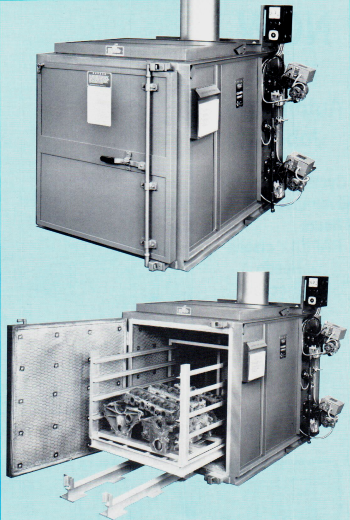
The Pollution Control Products DC-3 is a mid-size industrial burn-off oven engineered for safely removing coatings, carbon, grease, plastic, paint, and other combustible organics from metal parts. Ideal for automotive, engine-rebuilding, industrial maintenance, and manufacturing facilities, the DC-3 provides a larger work chamber than the DC-2A while maintaining the same proven safety and emission-control technologies.
The DC-3 uses controlled pyrolysis — a low-oxygen, temperature-regulated process — to break down organic material without damaging the base metal. The oven’s integrated afterburner system ensures clean exhaust by destroying smoke, VOCs, and odor before they leave the stack. This makes the DC-3 a reliable solution for shops that need environmentally compliant parts cleaning with minimal operator involvement.
With its increased capacity, robust construction, and automatic operating cycles, the DC-3 is a workhorse oven built to handle heavier loads and more frequent burn-off cycles.




| Specification | Value |
|---|---|
| Model | DC-3 |
| Chamber Dimensions | Approx. 36″ × 36″ × 48″ (varies by unit) |
| Burn-Off Method | Controlled pyrolysis (low-oxygen burn) |
| Afterburner Type | High-temperature downdraft oxidizer |
| Max Operating Temperature | Typically 650–800°F (controlled cycle) |
| Fuel Source | Natural Gas or LP Gas |
| Electrical Requirements | Standard industrial 3-phase (varies by build) |
| Construction | Insulated steel exterior; refractory-lined interior |
| Typical Applications | Engine parts, fixtures, tooling, paint removal, carbon removal |
Tell us what you need, and we’ll send you a quick and accurate estimate — no hidden fees, no obligations.
We make equipment decisions easy. Clear answers, accurate recommendations, and support from people who know the industry.
When you reach out, you get answers quickly - not generic replies.
Backed by 50+ years in engine machining and reconditioning.
No surprises, no unclear timelines.
Your machine’s long-term performance is our priority.

Decades before today’s engine shops trusted our equipment, Tony was already deep in the craft — rebuilding motors, machining blocks, and pushing for better precision.
A local newspaper once featured him as a standout young machinist, noting his drive, attention to detail, and obsession with doing things the right way. That same passion would eventually shape our company’s values.
Today, that commitment lives on in every machine we sell, every customer we support, and every shop we help succeed.